On the morning of September 19, Peking University held a celebration marking the 80th anniversary of Oriental Studies at the Sunshine Hall of Peking University Overseas Exchange Center. Attendees included Gao Song, President of Peking University; Nyamaa Enkhbold, Ambassador of Mongolia to China; Vikram Doraiswami, Ambassador of the Republic of India to China; Fang Fang, member of the Standing Committee of the CPC Peking University Committee and Vice President of Peking University; Wang Bangwei, Honorary Dean of the Institute of Oriental Studies at Peking University; Xu Jun, Senior Professor of Humanities at Zhejiang University and Chief Expert of its Institute of Asian Civilizations; and alumni representative Dai Shaoan, former military attaché at the Chinese Embassy in Egypt. More than 300 faculty members, students and alumni of Oriental Studies joined heads of relevant University offices and other schools and departments at the event. Li Shujing, Party Secretary of the School of Foreign Languages, presided over the celebration.
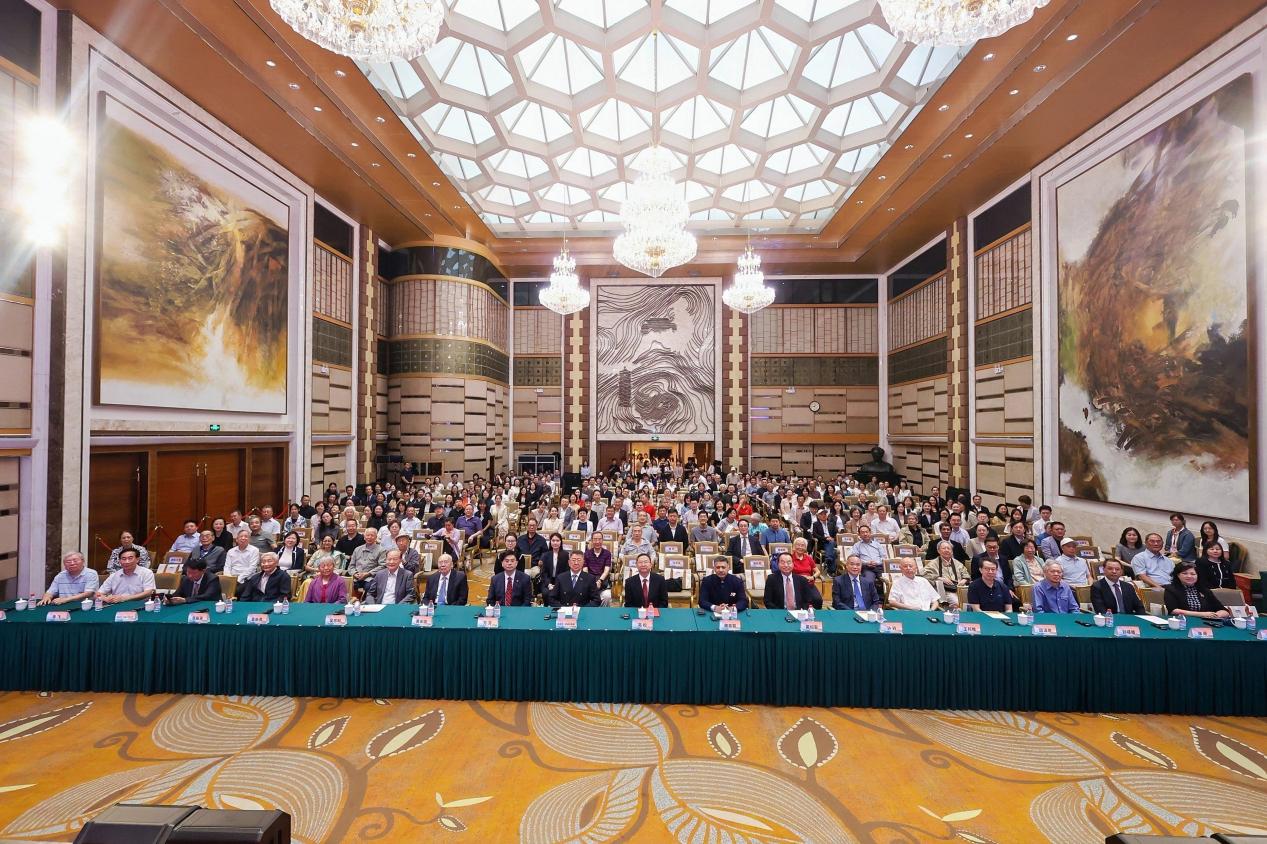
At the celebration
In his opening remarks, Gao Song congratulated the field of Oriental Studies on its 80th anniversary on behalf of the University. He reviewed the eight-decade journey of successive generations of scholars, exemplified by Mr. Ji Xianlin, who passed the torch from one generation to the next. Gao noted that Oriental Studies at Peking University has consistently advanced in step with national development and the needs of the times. He called on the field to build on its strong traditions, deepen area and country studies, promote interdisciplinary innovation and strengthen its faculty. These efforts, he said, would enable it to assume greater responsibility and make new contributions to developing philosophy and social sciences with Chinese characteristics, building an independent Chinese knowledge system and promoting exchanges and mutual learning among civilizations.
Wang Bangwei reviewed the scholarly traditions and development of Oriental Studies at Peking University. He said that the field depends on sustained work across generations and must remain grounded in rigorous language training and textual research while responding to new questions raised by the times.
Vikram Doraiswami said that language and cultural studies provide an essential foundation for mutual understanding among countries. He expressed the hope that Peking University would create more opportunities for people-to-people and cultural exchanges between India and China. Nyamaa Enkhbold commended Peking University for its contributions to research on Mongolian language and culture and to exchanges between Mongolia and China, and called for closer ties in education, culture and youth engagement.
Xu Jun said that Oriental Studies should pursue in-depth research into individual languages, literatures and histories while broadening its interdisciplinary horizons. Comparative study and dialogue among civilizations, he observed, could open new directions for research. He expressed the hope that Oriental Studies at Peking University would continue to lead the field and make still greater contributions to national development, the training of specialists and the development of an independent Chinese knowledge system for Oriental Studies.
Wang Hao, a faculty representative and professor in the Department of Asian-African Languages and Literatures, reflected onherteaching and research in Oriental languages and cultures. She said she would carry forward the responsibilities of scholars in the field through education and academic inquiry. Alumni representative Dai Shaoan recalled studying Arabic in the former Department of Oriental Studies. Drawing on his experience in military diplomacy, he explained how his training in Oriental Studies had been translated into a practical capacity for serving the country and building bridges between civilizations.
Four student representatives shared their experiences of learning Oriental languages and engaging with the civilizations of the East: Tong Zihan, an undergraduate in the Department of Japanese Language and Culture; Huang Jiaxin, a graduate student in the Department of Korean Language and Culture; Chang Jiarui, an undergraduate in the Department of West Asian Languages and Cultures; and Pan Yue, an undergraduate in the Department of Southeast Asian Studies. They expressed their determination to carry forward the scholarly spirit of earlier generations and apply their learning to exchanges and mutual learning among civilizations. Their remarks reflected the commitment, energy and sense of responsibility with which young scholars are continuing the tradition of Oriental Studies.
Chen Ming, Dean of the School of Foreign Languages, said that the School would cherish the scholarly tradition developed over the past 80 years, draw on support from all quarters and advance Oriental Studies by upholding its core traditions while pursuing innovation.
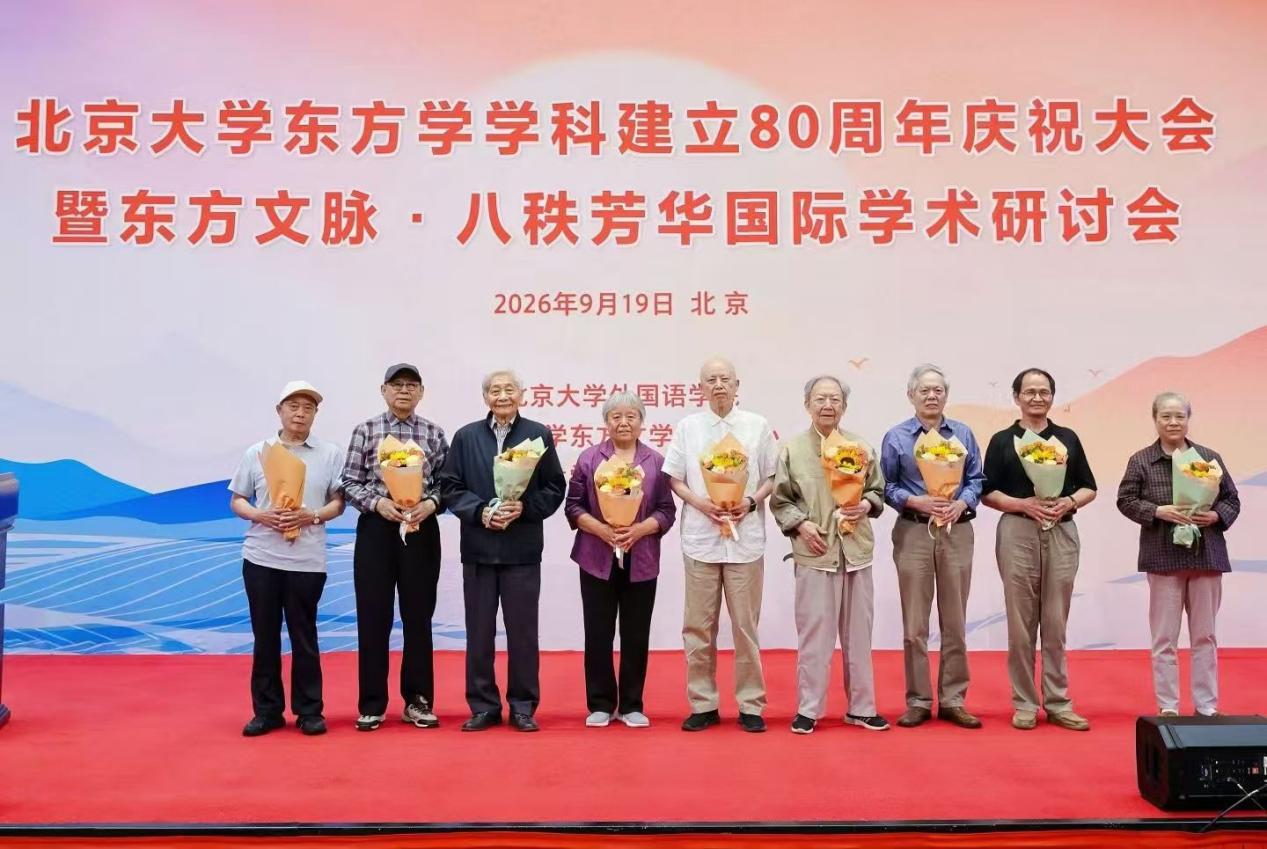
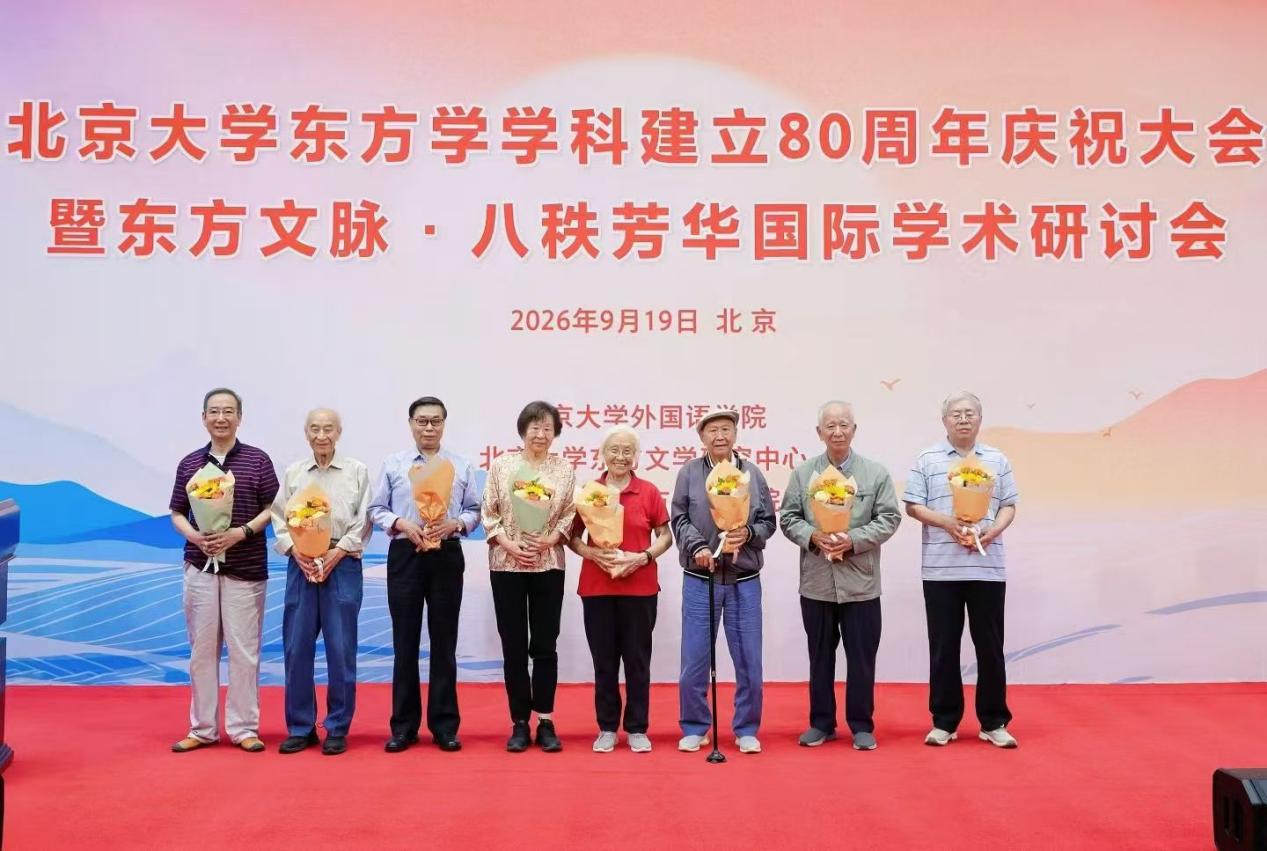
Students presented flowers to senior faculty representatives
During the celebration, students presented flowers to senior faculty representatives.
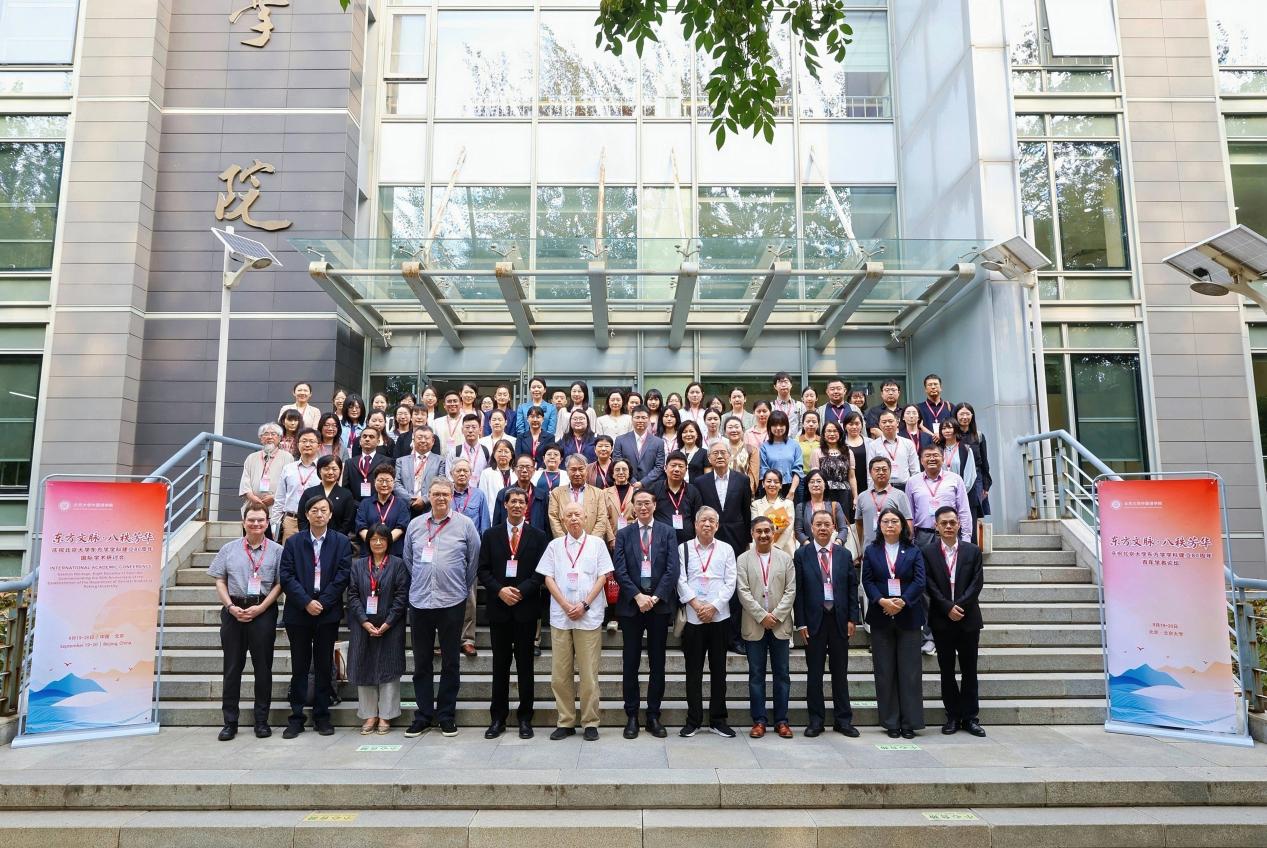
Group photo
Following the celebration, more than 100 scholars from 50 universities and research institutions across 10 countries and regions attended the International Symposium and Young Scholars Forum Commemorating the 80th Anniversary of Oriental Studies at Peking University, held under the theme “Eight Decades of Scholarly Tradition.” Participants presented their research and raised questions for further discussion on the history and intellectual traditions of Oriental Studies; languages, scripts and classical texts; literature, art, religion and philosophy; area and country studies and independent knowledge systems; and knowledge production in the age of artificial intelligence.
Further Reading
Since Ji Xianlin returned to China and founded the Department of Oriental Languages and Literatures in 1946, Oriental Studies at Peking University has developed over eight decades. Peking University is both the birthplace of Oriental Studies in China and a major center for research and education in the field. From the outset, the program has served China’s international engagement and cultural exchange. Over the past 80 years, it has educated more than 8,000 undergraduates and over 1,000 master’s and doctoral students, preparing many specialists with proficiency in Oriental languages and a deep understanding of regional cultures for careers in diplomacy, culture and academia. Its alumni include numerous ambassadors, senior diplomats, leading scholars and industry figures. Major publications such as the The Oriental Cultures Series, with more than 200 titles published, the 18-volume Persian Classics Library and the 24-volume Complete Works of Rabindranath Tagore have had a significant influence on Chinese scholarship. Several research fields within Oriental Studies at Peking University now rank among the world's leading ones. Its research on ancient Indian languages and texts, Tocharian studies and classical Oriental literature has received wide international recognition. Faculty members in the field have received more than 100 major awards in China and abroad, including over 30 international honors such as presidential medals, prime ministerial medals and cultural medals.
Translated by Zhou Junxia